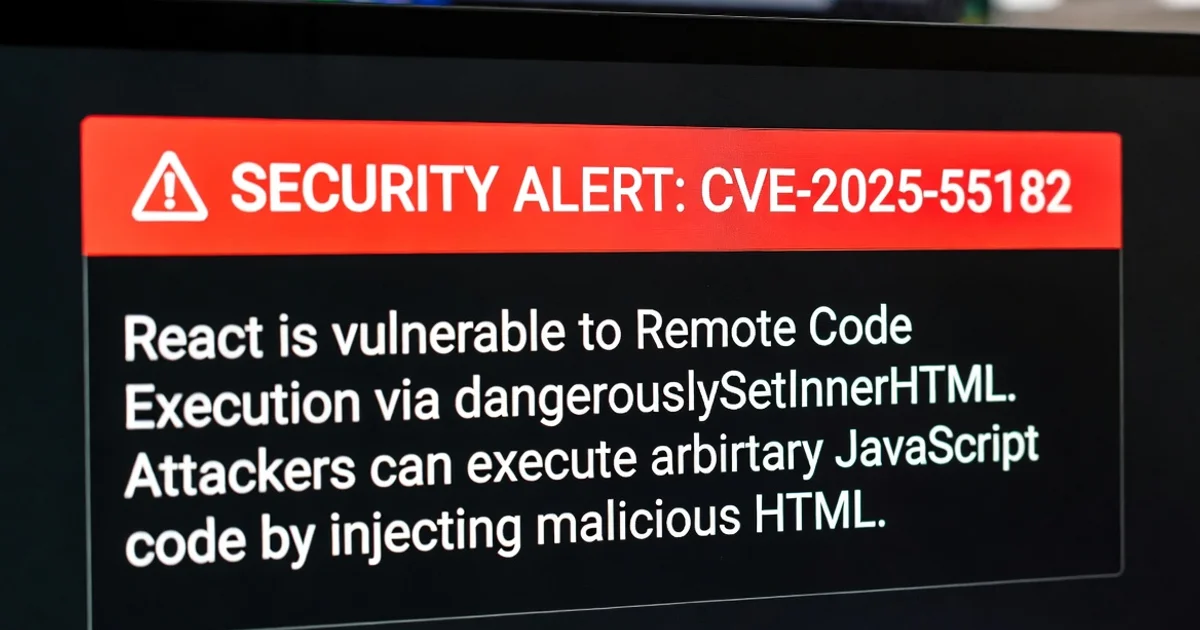
React's RCE Wake-Up Call - Patch Before Hackers Say 'Hello World'
React’s RCE Wake-Up Call: Patch Before Hackers Say “Hello World”
Picture this: You’re sipping coffee, deploying your shiny Next.js app to prod, feeling like the king of full-stack JavaScript. Then, bam – a vulnerability drops that’s basically handing attackers a free SSH key to your server. Welcome to CVE-2025-55182, the critical RCE bug that’s got the React world scrambling faster than you chasing a buggy merge conflict.
Disclosed on December 3, 2025, this one’s a doozy: CVSS 10.0, unauthenticated remote code execution via… wait for it… insecure deserialization in React Server Components (RSC). It’s like trusting a shady package.json install without running npm audit. If your app uses RSC (or frameworks like Next.js that do), it’s time to roll up those sleeves.
(And yes, I double-checked my own deploys this morning. Paranoia is free; breaches cost millions.)
The Nitty-Gritty: What Even Happened?
At its core, this vuln lives in how React’s “Flight” protocol – the magic behind Server Components – handles incoming payloads for Server Functions. Think of it as React trying to unpack a surprise gift from an uninvited guest.
Here’s the tragic comedy of errors:
- An attacker crafts a malicious HTTP request to a Server Function endpoint (no auth needed – because why not make it easy?).
- React’s
react-serverpackage cheerfully deserializes the payload without proper validation. It’s like feeding unescaped user input straight toeval(). - Boom: Arbitrary code runs on your server. “Hello World” could be “rm -rf /” or “mine Bitcoin in the background while you debug logs.”
The root? Unsafe deserialization of RSC payloads. Discovered by Lachlan Davidson via Meta’s Bug Bounty on November 29, it got patched lightning-fast by December 1, with public disclosure yesterday. Props to the React team for the speedrun – from report to npm publish in under 72 hours.
Affected versions: React 19.0 through 19.2.0. Next.js gets its own CVE-2025-66478 for the inherited pain, hitting versions before 16.0.7, 15.5.7, and 15.4.8. Wiz reckons 39% of cloud envs are exposed, with Next.js lurking in 69%. If that’s not a “check your deps now” stat, I don’t know what is.
Fun fact: No in-the-wild exploits yet (as of this morning), but give it a day. Script kiddies love a good deserialization party.
Who’s in the Crosshairs? (Spoiler: Probably You)
This isn’t just a React thing – it’s an ecosystem apocalypse:
- Core React: Versions 19.0-19.2.0 with Server Components enabled.
- Next.js: The poster child, but Vercel had WAF rules up before the CVE even dropped.
- Others: React Router, Vite, Parcel, Expo, Redwood SDK, Waku – if they touch RSC, they’re sweating.
- Your Setup: Server-side rendering? API routes? If you’re processing untrusted Flight requests, congrats, you’re vulnerable.
Even if you’re not using Server Functions explicitly, the protocol’s baked in. It’s like that one unused middleware that still logs your secrets.
The impact? Full server compromise. Data exfil, ransomware, or just hackers using your AWS bill for crypto mining. In a world where React powers half the web, this is “Log4Shell for frontend devs” territory.
The Fix: Don’t Panic, Just Patch (With a Side of Humor)
Good news: The cavalry arrived. React dropped 19.2.1 with a deserialization sanity check. Here’s your battle plan:
- Update React:
npm update react react-domto 19.2.1+. For Next.js: Bump to 16.0.7 (or patch branches). Runnpm auditfor good measure – because why not audit while you’re at it? - Temporary Shields:
- Cloudflare auto-protected WAF users yesterday – no action needed if you’re orange-clouded.
- Google Cloud rolled out a Cloud Armor rule; enable it for your load balancers.
- Vercel? Already blocked. Firebase Hosting too.
- Akamai’s got a rapid rule (3000976) for App & API Protector.
- Verify & Test: Spin up a staging env, fuzz those endpoints with a PoC (Tenable says none public yet, but OWASP ZAP is your friend). Then deploy with zero-downtime – because rolling updates are your therapist in times like these.
Pro tip: Add input validation to any custom RSC handlers. Deserialization is the IT crowd’s “have you tried turning it off and on again?” but with more firewalls.
DevOps Takeaways (Because We’re Not Just React Wranglers)
This vuln is a classic reminder: Frontend security is backend security now. Server Components blurred the lines, and attackers noticed.
- Audit Everything: Tools like Snyk or Aikido can flag this in your pipeline.
- WAFs Aren’t Optional: Proxy everything through one. It’s cheaper than incident response.
- Immutable Deps: Lock your
package-lock.jsonand scan on every PR. - Chaos Test: Break your deserialization in staging. Better simulated RCE than real regret.
- Mindset Shift: Treat JS like it’s C – buffer overflows are so 2024, deserialization is the new black.
In the spirit of my Node.js deployment guide (because who doesn’t love Dockerizing their way out of trouble?), containerize with vulnerability scans baked in. Your Kubernetes probes will thank you.
Wrapping Up: From “Oh No” to “All Good”
CVE-2025-55182 is a wake-up call wrapped in a gift bow of quick patches. Update today, enable those mitigations, and laugh at the what-ifs over your next coffee. The React team’s response was textbook – fast, coordinated, and zero drama.
Stay vigilant, folks. In DevOps, the only thing worse than a vuln is ignoring it while binge-watching Netflix on a compromised server.
P.S. If your app’s suddenly mining Dogecoin, blame the unpatched RSC, not your side hustle.
UPDATE: Official React advisory here. Next.js too.
Until next time – may your payloads be sanitized and your exploits few.
😎
// RELATED_ARCHIVES
> Dec 2025 · 7 min read
React's React2Shell Hack: When Your UI Library Gets a Backdoor
A critical RCE bug (CVE-2025-55182) in React Server Components let hackers shell into millions of servers. Patch now, or your app's serving more than just JSX.

> Dec 2025 · 5 min read
AWS's New AI Coders: Will They Finally Fix My Deployments?
AWS just dropped AI agents that can write, debug, and deploy code like a caffeinated intern. DevOps pros rejoice (or panic)

> Nov 2025 · 7 min read
The Cloud Is Just Someone Else’s Computer – Time to Go Local-First!
What if your app worked perfectly offline, synced magically, and you actually owned the data? Spoiler: it’s not sci-fi anymore.