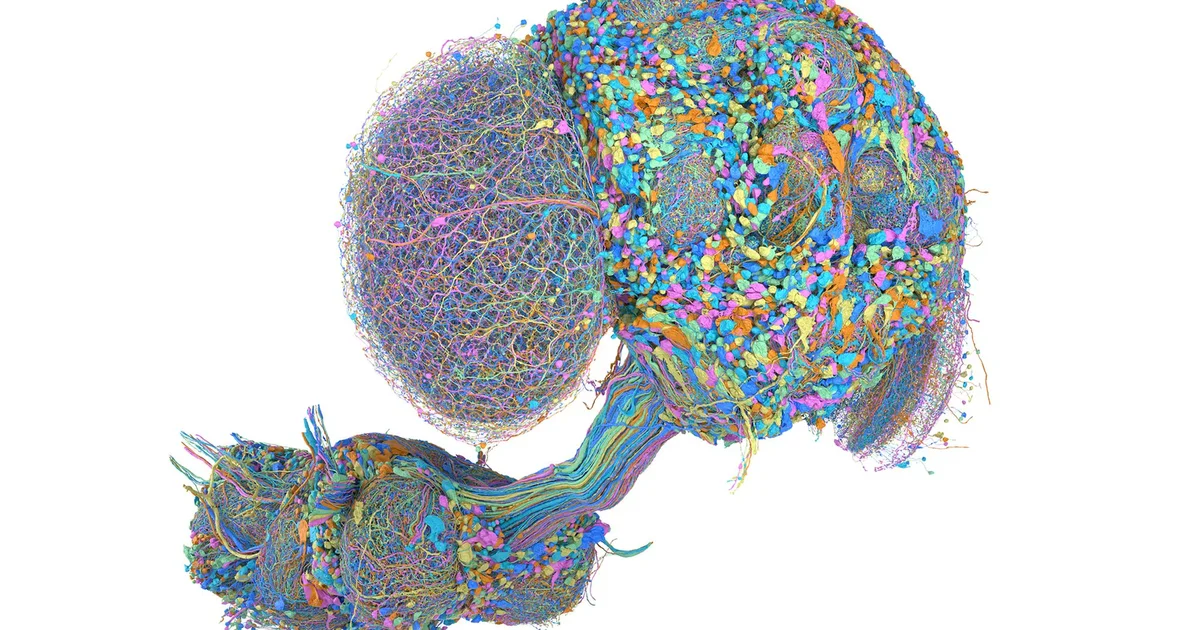
They Mapped a Fly Brain. The Internet Made It Play Doom
On September 3, 2026, Google Research and HHMI Janelia quietly dropped one of those papers that should have stayed in the “serious neuroscience” lane.
A complete wiring diagram of an adult male fruit fly. Brain and ventral nerve cord. Every cell, most of the synapses, annotated, proofread, released.
Headline numbers: more than 166,000 neurons, about 125 million synaptic connections, ~11,700 cell types. Largest brain map by neuron count to date.
The internet read “open dataset” and heard “new game engine.”
Within days the same MaleCNS v1.0 graph was walking around Minecraft, overfit on Beat Saber, and taking damage in Doom. This is either the best possible advertisement for open science, or proof that humanity cannot be trusted with a USB stick.
Both can be true.
What They Actually Mapped (The Serious Bit)
Fruit flies are the unsung SRE of biology. Small, cheap, genetically scriptable, and just complicated enough that “how does this thing decide to court / fight / walk toward a smell” is still a real question. Previous maps were mostly female: the 2020 hemibrain, then FlyWire’s full adult female brain (~139k neurons).
This one is the first finished male central nervous system — central brain, both optic lobes, and the ventral nerve cord (the fly’s spinal cord analogue) with the neck connective still attached. That last part matters. You can finally trace a sensory input in the head all the way to a motor output in the body without hopping datasets like a desperate traceroute.
The volume itself is slightly unhinged:
- 7 enhanced FIB-SEM microscopes
- 13 months of imaging
- 160 teravoxels at 8 × 8 × 8 nm
- 0.082 mm³ of fly
Then AI stitches the slices into 3D shapes (flood-filling networks, PATHFINDER, synthetic neurons in the training set so the model stops inventing spaghetti), and humans at Janelia spend an unholy number of hours proofreading the result. Cambridge, MRC-LMB, and Google Research are all on the author list. It is the kind of collaboration where neither side could have shipped without the other.
You can poke it in Neuroglancer, query it in neuPrint, download it, and — this is the important sentence — it is licensed CC-BY. That last choice is why the next section exists.
Boys vs Girls, But Make It Synapses
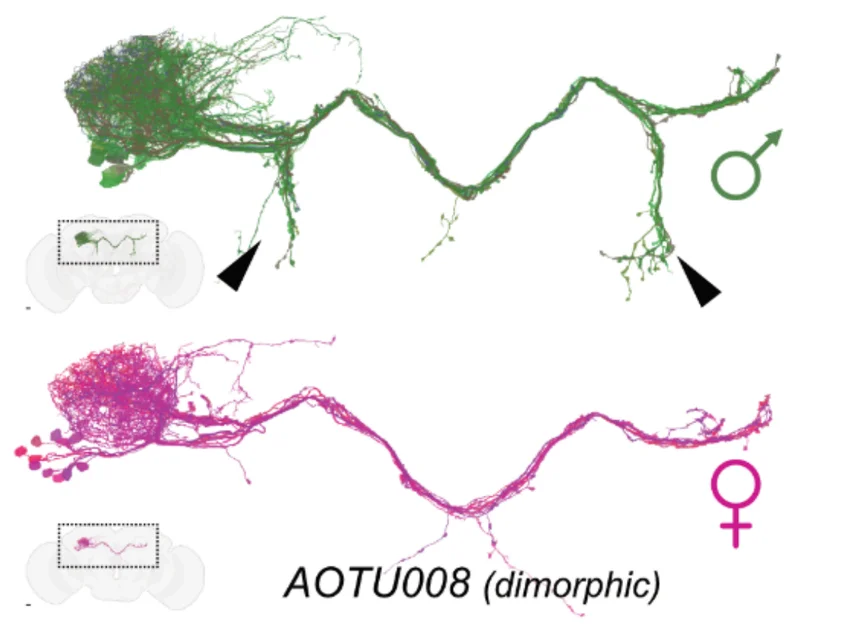
The scientific hook is sexual dimorphism at synaptic resolution. First time anyone has been able to put a male and female adult brain next to each other and ask “which wires actually differ?”
Most of the CNS is isomorphic — same types, same-ish wiring. The interesting remainder is not. Across papers you’ll see slightly different counts depending on how strict the matching rules are, but the picture is stable: on the order of a few hundred sex-specific or dimorphic types, concentrated in higher integrative centres, not in the sensory and motor periphery. Courtship and aggression live in the weird middle of the graph, which is exactly where a theologian and a systems person would have guessed.
The poster child is AOTU008: the male version grows extra projections the female version does not. Tiny morphological fork, large behavioural fork. fruitless / doublesex expression correlates hard with dimorphism, but not perfectly. Biology refuses to be a clean feature flag.
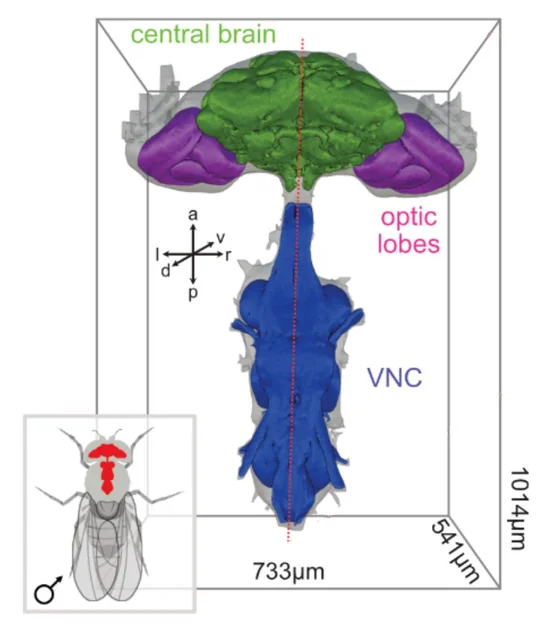
Companion papers already use the map on vision, taste, and social behaviour. The dataset is a tool, not a trophy.
Then X Happened
Google posted the pretty pictures. X treated them as a load-bearing API.
Exhibit A — Minecraft.
Evan Sinclair Smith (@evnsnclr) loaded the full MaleCNS v1.0 graph into Minecraft. Simulated activity on the reconstructed wiring drives a fly’s movement. He had to post a clarification almost immediately: this is not a uploaded consciousness. The edges are biological. The activity rules, the game inputs, and the “now flap / now groom / now panic” mappings are engineering. It is an interactive connectome viewer that happens to look like a cursed speedrun. The NeuroCraft Fly repo is public.
Exhibit B — Beat Saber.
@_lyraaaa_ got the fly brain swinging sabers. Early clip is motor-heavy and overfit to one track, with teacher-forced input still leaking in. The follow-ups are the honest part: visual reactivity is still being trained, RL is next, and “it will learn to play properly” is both a research plan and a threat. Someone in the replies asked the only reasonable question: what the fuck are you doing.
Exhibit C — Doom.
Alex Wormuth (@nftechie_) pointed Doom frames at sensory neurons, mapped population activity to controls, and poked two PPL101 dopamine cells when the fly took damage. Reinforcement via the actual-ish reward circuitry of a fruit fly, pointed at a 1993 FPS. Code is open. There is a live page. A reply asked whether anyone had considered that they were making the fly experience Doom. Nobody had, and then everybody did.
Tom’s Hardware even ran the headline so you don’t have to: software engineers immediately made it run Doom. Of course they did. That is the job.
Why This Is Not Just a Meme
Three things are true at once.
-
The science is real. A fully proofread male CNS with an intact neck connective is a new primitive. Sensory-to-motor loops that used to be a literature review are now a graph query.
-
The engineering lesson is familiar. You do not get 166k reconstructed neurons by hiring more tracers. You get them with models that propose shapes, humans who reject the bad ones, size/schema checks on the generated artefacts, and a viewer that can actually load the thing. Flood-filling networks and PATHFINDER are the “we automated the toil so experts can proofread” story. Neuroglancer is the “please do not email us a 160-teravoxel zip” story.
-
Open weights, open graphs, open chaos. The moment you publish a complete graph under CC-BY, someone will treat neurons as a new kind of bytecode. That is the point of releasing it. It is also why every dataset README should include a sentence that starts with “this is not a mind.”
The human brain is still ~86 billion neurons away. Fish and a slice of mouse are the next official stops. Unofficially, the next stop is whatever game has a public input API and a dopamine joke.
Practical Takeaways (Yes, Even for People Who Deploy APIs)
- Publish the artefact, not just the paper. neuPrint + Neuroglancer + a bucket beat a PDF figure every time.
- Proofreading is the prod incident review. Automation gets you 90%. The last 10% is still a human staring at a weird branch and saying “that cell does not exist.”
- Interfaces beat raw dumps. If your 160-teravoxel dataset cannot be queried, it is a museum piece.
- Expect the Doom port. If your system is complete enough to be interesting, someone will wire it to a game. Budget one weekend of “please stop calling this consciousness” comms.
Final Thought
We spent a decade slicing a fly, training networks to recognise its wiring, and arguing about sexual dimorphism in a cubic millimetre of tissue. Then we handed the graph to the timeline and it learned (poorly, then less poorly) to slice blocks to a beat.
That is the most honest demo of “the map is not the territory” I have seen this year. The map is extraordinary. The territory is still a fly. The Minecraft overlay is a commentary track.
Stay curious. Keep your datasets small enough to finish and open enough to abuse. And if your on-call ever includes a fruit fly in E1M1, I don’t want to hear about it.
Until next time — may your reconstructions be proofread and your dopamine cells unstimulated.
P.S. Official sources if you want to actually use this thing instead of making it play games: Google Research post, Cell paper, MaleCNS project page.
// RELATED_ARCHIVES

> Jun 2026 · 6 min read
NVIDIA RTX Spark: Laptops Become AI Teammates (Finally?)
NVIDIA just fused Blackwell AI and RTX graphics into one super-efficient chip for slim laptops and tiny desktops. Your PC is no longer just a tool — it’s now your slightly over-caffeinated coding buddy.
> Mar 2026 · 5 min read
Vercel's Chat SDK: One Codebase to Rule All Chat Platforms
Tired of maintaining separate bot code for Slack, Discord, Teams and more? Vercel's new Chat SDK (npm i chat) lets you write logic once and deploy everywhere. Here's why it's a game-changer (with zero platform rage).

> Feb 2026 · 5 min read
Anthropic Unleashes Claude Opus 4.6 – Agents & Coding Level Up, No Price Hike
Anthropic's latest Opus upgrade brings 1M context, smarter agents, epic coding boosts, and more – all while keeping your wallet happy. Let's unpack the goodies.